 ultimate-guide
Move Act: What Homeowners Need to Know
Table of Contents
- What Is the Move Act?
- How Portable Mortgages Work Under the Move Act
- Portable Mortgage Benefits for Homeowners
- Pros and Cons of Portable Mortgages
- Mortgage Interest Rate Lock-In and the Move Act
- Current Legislative Status and Timeline
- Impact on First-Time Homebuyers and the Housing Market
- Frequently Asked Questions
Last Updated: October 2, 2026
What Is the Move Act?
The Move Act (Making Ownership Viable for Everyone Act) is a proposed federal bill that would allow homeowners to transfer their existing mortgage terms and interest rates to a new property when they relocate, rather than refinancing at current market rates.
The Move Act addresses a key friction point: when homeowners sell and buy a new property, they lose their existing mortgage. If interest rates have risen, they must accept higher rates or refinance at significant cost. Portable mortgages would allow borrowers to carry their rate lock and loan terms to their next purchase.
Unlike traditional mortgage assumptions (which apply only to the same property), the Move Act would make mortgages transferable across different properties and lenders, increasing housing market liquidity and affordability by reducing barriers to mobility caused by interest rate fluctuations.
How Portable Mortgages Work Under the Move Act
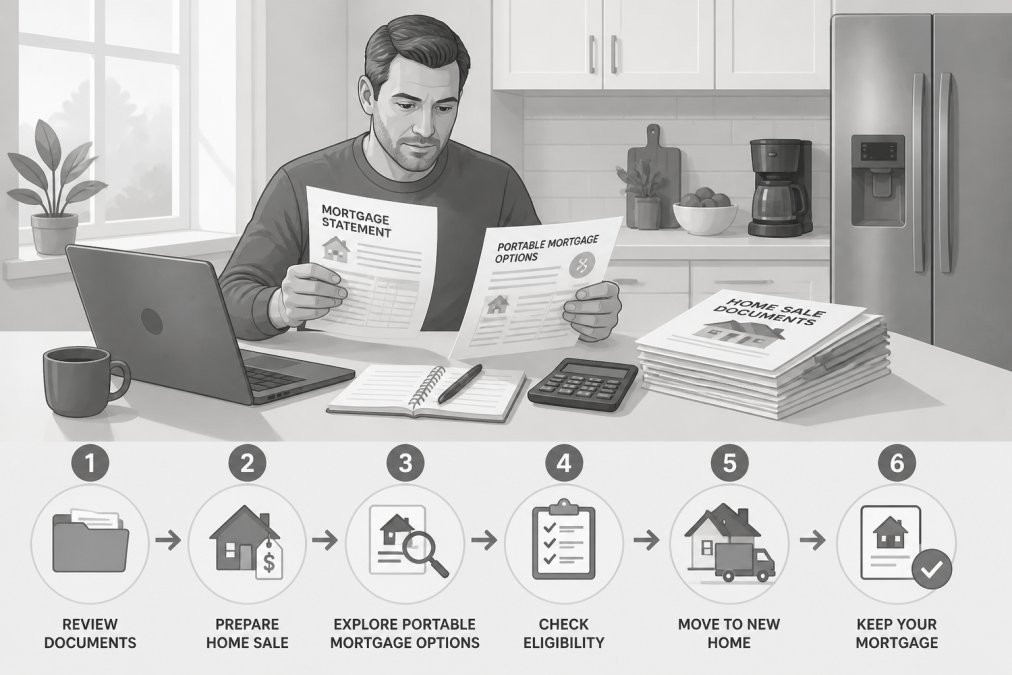
Portable mortgages would function through securitization similar to current mortgage-backed securities. When a homeowner sells, the lender would not close the loan; instead, the mortgage balance transfers to the new property, maintaining the original interest rate and loan term.
The mechanics require the lender to release the lien on the original property and place it on the new one, which must meet underwriting standards. Fannie Mae and Freddie Mac would securitize these mortgages and ensure consistent standards across the market.
For a homeowner: you sell your current home with a 3.5% mortgage and transfer it to your new purchase instead of refinancing at 6.2%. Your monthly payment remains largely unchanged because your rate and term stay the same.
The model creates operational challenges. A homeowner selling a $500,000 home with a $300,000 mortgage balance who buys a $750,000 home would need a second mortgage or larger down payment for the difference. Mortgage servicing also becomes complex, requiring updated appraisals, title work, and compliance verification for each new property.
Portable Mortgage Benefits for Homeowners
The primary benefit is rate protection. Homeowners with favorable rates preserve that advantage across multiple home purchases. If you locked in a 3.5% mortgage and rates rise to 6% or higher, your portable mortgage maintains that advantage throughout your life.
A homeowner maintaining a 3.5% rate instead of refinancing at 5.5% saves approximately $200 per month. Over a 30-year loan, this compounds substantially, potentially hundreds of thousands of dollars in cumulative savings across multiple transactions.
Portable mortgages reduce transaction friction by eliminating refinancing, simplifying the process and providing certainty about post-purchase monthly obligations, important when relocating for job changes, family needs, or lifestyle preferences.
The Move Act could particularly benefit homeowners in high-appreciation markets, where preserving favorable rates when upgrading or relocating removes a disincentive to move.
Pros and Cons of Portable Mortgages
The advantages of portable mortgages extend beyond individual homeowner benefits. Market liquidity would likely improve, as homeowners face fewer barriers to relocation. This could increase housing supply in desirable markets, as current homeowners would more readily sell and upgrade their properties rather than staying put to avoid rate penalties.
However, portable mortgages introduce significant complications for lenders and the mortgage servicing industry. Traditional mortgages are relatively straightforward: a borrower obtains a loan on a specific property, and the lender retains the mortgage until payoff or refinancing. Portable mortgages require lenders to manage loans across multiple properties, updating collateral valuations and managing title transfers.
Risk assessment becomes more difficult under a portable mortgage model. A lender initially evaluates a borrower and a specific property when originating the loan. When that mortgage transfers to a different property, the lender's risk profile changes. A homeowner might sell a property in a stable neighborhood and purchase one in a declining area, or vice versa.
Lenders also face challenges with seasoning and credit history. A homeowner with a 20-year-old mortgage has demonstrated two decades of reliable payment history. However, that same borrower's current credit situation might have deteriorated.
The secondary market complications are substantial. Fannie Mae and Freddie Mac would need to establish new underwriting standards, pricing mechanisms, and risk management frameworks for portable mortgages. Mortgage-backed securities backed by these loans would carry different characteristics than traditional mortgages, requiring new rating methodologies and investor education.
Mortgage Interest Rate Lock-In and the Move Act
The Move Act fundamentally changes how mortgage interest rate lock-in functions in the housing market. Currently, your interest rate is tied to the specific loan on the specific property. When you sell that property, the rate lock expires. Under the Move Act, the interest rate lock would become portable, transferring with the mortgage to the new property.
This creates a form of rate arbitrage opportunity. Homeowners with below-market rates would gain negotiating use in real estate transactions. A seller with a 3.5% mortgage could potentially command a premium for their property because the buyer could assume that favorable rate. This could actually increase home prices in scenarios where buyers value rate preservation more highly than they value other property characteristics.
However, this pricing dynamic introduces new complications for the real estate market. Property valuations become partially dependent on the attached mortgage rate rather than purely on the property's intrinsic value. Appraisers would need to develop new methodologies for accounting for portable mortgage premiums.
The interest rate lock-in feature also affects mortgage lenders' business models. Currently, lenders profit from the spread between the interest rate they pay for funds and the rate they charge borrowers. Portable mortgages lock in that spread for the duration of the loan, even as market conditions change. This reduces lenders' flexibility to adjust their business strategies as interest rate environments shift.
Current Legislative Status and Timeline
H.R. 10028 represents the primary legislative vehicle for introducing portable mortgages into federal housing policy. The bill has been introduced but has not yet advanced through the committee process as of 2026. Legislative progress on housing finance reform moves slowly, as the mortgage market involves substantial stakeholder interests including lenders, investors, government-sponsored enterprises, consumer advocates, and real estate professionals.
The legislative process for new bills typically requires several stages. A bill must be introduced, referred to committee, debated and amended, voted on in committee, then considered by the full House. If it passes the House, it must repeat the process in the Senate.
Several factors influence the timeline for the Move Act. The current state of interest rates affects urgency; when rates are low and stable, there is less pressure to implement portable mortgage systems. When rates rise sharply, as they did in 2022-2023, homeowners face greater incentives to support policy changes that would preserve favorable rates.
Fannie Mae and Freddie Mac have significant influence over housing finance legislation. These government-sponsored enterprises would bear substantial implementation costs for portable mortgages and would need to support the policy for it to succeed. Their position on the Move Act will likely determine its viability.
If the Move Act advances through Congress and becomes law, implementation would require substantial lead time. New underwriting standards would need to be developed, mortgage servicing systems would require modification, and secondary market participants would need to prepare for trading portable mortgages.
Impact on First-Time Homebuyers and the Housing Market
First-time homebuyers would experience the most significant impact from the Move Act. This group typically obtains mortgages when they are younger and have less accumulated wealth.
Consider a first-time buyer who purchases a starter home at age 28 with a 3.5% mortgage rate. Under current rules, when they sell that home at age 35 to upgrade to a larger property, they must refinance at the prevailing market rate.
However, the Move Act could also create equity-related complications for first-time buyers. Sellers with favorable rates would have incentive to price their properties higher, knowing that buyers could assume the attractive mortgage.
The broader housing market impact depends heavily on implementation details. If portable mortgages become widespread, housing inventory could increase as current homeowners feel less constrained by favorable rates.
Conversely, if portable mortgages create a two-tier market where properties with favorable rates command premiums, price volatility could increase.
The Move Act could also influence regional housing market dynamics. In high-appreciation markets where property values rise faster than elsewhere, homeowners with old mortgages at very favorable rates would gain substantial advantages.
The Move Act represents a significant potential shift in how homeownership works in the United States.
At 805forsale.com, we help buyers and sellers navigate the complexities of real estate transactions, including understanding how policy changes like the Move Act could affect your home purchase or sale strategy.
Frequently Asked Questions
What is the Move Act in Congress?
The Move Act, formally the Making Ownership Viable for Everyone Act (H.R. 10028), is a proposed federal bill that would allow homeowners to transfer their existing mortgage terms and interest rates to a new property when they relocate. Instead of refinancing at current market rates, homeowners could carry their original mortgage rate to their next home, creating what's known as a portable mortgage. The bill aims to increase housing market liquidity and reduce the financial barriers homeowners face when selling during periods of rising interest rates.
What are the portable mortgage benefits under this proposal?
Portable mortgage benefits include the ability to lock in your current interest rate when moving to a new home, avoiding the need to refinance at potentially higher rates. This reduces the financial shock of relocating and makes homeownership more affordable during transitions. For sellers, portable mortgages could increase buyer interest by allowing purchasers to assume favorable loan terms. The broader benefit is improved housing market liquidity, as homeowners won't be anchored to their current property by a low mortgage rate they fear losing.
Is the Move Act currently law?
No, the Move Act is not currently law. H.R. 10028 remains a legislative proposal in Congress. While the bill has generated interest from policymakers and housing advocates, it has not yet passed both chambers of Congress or been signed into law. The legislative process for new bills involves committee review, debate, amendments, and votes in both the House and Senate before becoming law. Homeowners should monitor the bill's status through Congress.gov or speak with a real estate professional who can provide updates on its progress.
How would portable mortgages compare to existing assumable mortgages?
Assumable mortgages, available on some FHA and VA loans, allow a buyer to take over the seller's existing loan. Portable mortgages under the Move Act would work differently: the original borrower keeps the mortgage and transfers it to a new property, rather than passing it to a buyer. This gives homeowners more control and flexibility, as they could move multiple times while retaining their original rate. Assumable mortgages benefit buyers; portable mortgages benefit sellers and the homeowner making the move, addressing different pain points in the real estate transaction.