 listicle
Buying Investment Property in Ventura County: 2026 Guide
Table of Contents
- Why Ventura County Still Works for Real Estate Investors in 2026
- Ventura County Market Snapshot: Prices, Rents, and Cap Rates
- Types of Investment Property in Ventura County: What to Buy
- Best Neighborhoods in Ventura County 2026: Where to Buy
- How to Run the Numbers: Cash Flow, Cap Rate, and ROI
- Tax Strategies and 1031 Exchanges for Ventura County Investors
- Rental Regulations and Climate Risk: What to Check Before You Buy
- Common Mistakes to Avoid When Buying Investment Property
- Frequently Asked Questions
Last Updated: September 8, 2026
Buying investment property in Ventura County remains one of the more compelling paths to building long-term wealth in Southern California, but the market now rewards preparation over impulse. Coastal access, a diversified economy, and steady population growth keep demand strong, yet rising prices and tighter inventory mean the window for a good deal closes fast.
TL;DR:
- Ventura County offers a blend of coastal appreciation and inland cash flow that few California markets match
- Multi-family properties in cities like Oxnard and Santa Paula typically deliver stronger immediate yield
- Single-family rentals and condos favor investors prioritizing long-term appreciation over monthly cash flow
- Cap rates here run lower than national averages, so underwriting must be conservative
- Property taxes, insurance, and local rental regulations can change your ROI by several points
Why Ventura County Still Works for Real Estate Investors in 2026
Most investors assume the best California opportunities vanished years ago. Ventura County tells a different story. The region sits close enough to Los Angeles to benefit from its economic spillover, far enough to avoid its pricing extremes. Buying investment property in Ventura County gives you access to a rental market driven by defense, healthcare, and agricultural employment sectors that have proven resilient through economic cycles.
The county's appeal also rests on a simple supply constraint. The Pacific Ocean borders one side, and protected national forest borders the other. That geography caps new development, which historically supports both price appreciation and rental demand.
Ventura County Market Snapshot: Prices, Rents, and Cap Rates
Ventura County's housing market trends show a widening gap between coastal cities and inland communities. Median home prices in beach-adjacent areas run substantially higher than in eastern cities like Santa Paula or Fillmore, creating distinct entry points depending on your strategy and budget.
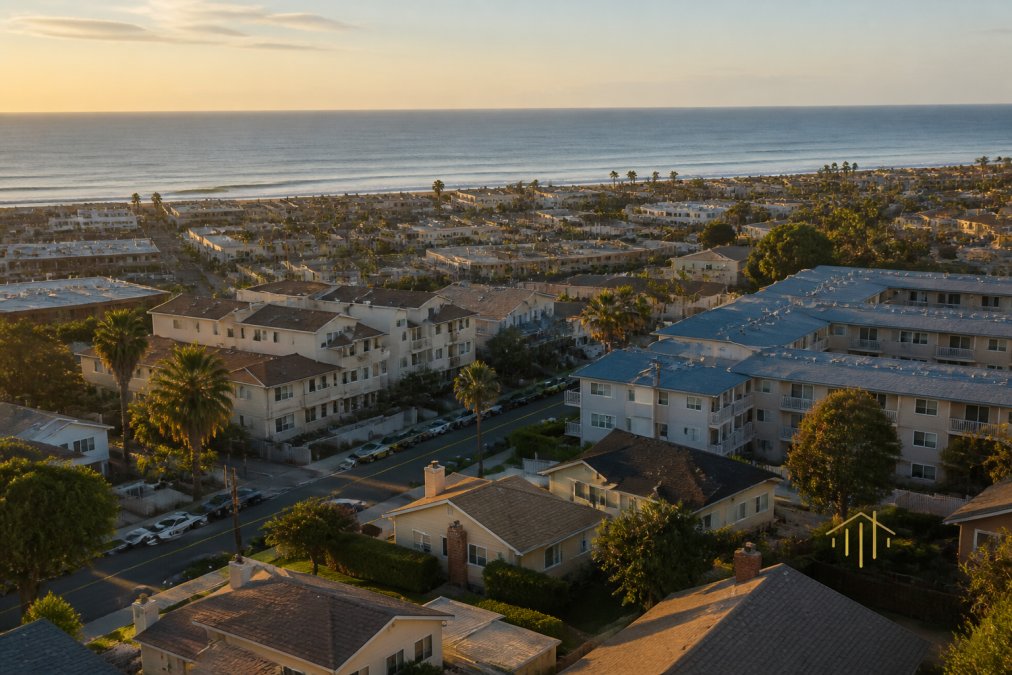
Cash flow math differs by city. Oxnard's larger multi-family inventory often produces better initial yield than coastal Ventura, where buyers pay a premium for proximity to the water. For a current snapshot of listing prices and inventory, Redfin's Ventura County housing market data tracks median prices and days-on-market in real time. Similarly, Realtor.com's Ventura County market report provides neighborhood-level listing analytics useful for comparing submarkets.
Types of Investment Property in Ventura County: What to Buy
Your property type determines your entire financial picture, from financing to tenant pool to exit strategy. Ventura County offers four main options, each with a different risk and return profile.
Ventura County Multi-Family Homes for Sale: The Cash Flow Play
For investors focused on immediate income, multi-family properties deserve the first look. Duplexes, triplexes, and small apartment buildings spread risk across multiple tenants, so a vacancy in one unit doesn't zero out your income. Searching for Ventura County multi-family homes for sale often surfaces opportunities in Oxnard and the eastern cities, where acquisition costs run lower.
The trade-off is management intensity: more maintenance calls, lease turnovers, and regulatory compliance. Many investors factor in property management costs before committing.
Single-Family Rentals and Condos: Appreciation vs. Yield
Single-family rentals in Ventura County typically generate lower cash flow relative to purchase price, but they attract longer-term, higher-quality tenants, often families who want access to the county's school districts. Appreciation potential is the primary driver here, and coastal markets have rewarded patient buy-and-hold investors consistently.
Condos sit in the middle: lower entry prices than single-family homes, but HOA fees eat into monthly returns and rental restrictions can limit flexibility. Before buying any condo as an investment, verify the HOA's rental policies and cap on investor-owned units.
Best Neighborhoods in Ventura County 2026: Where to Buy
The best neighborhoods in Ventura County 2026 depend heavily on your investment thesis. For cash flow, eastern cities like Santa Paula and Fillmore offer lower acquisition costs and solid rental demand from the agricultural workforce.
For appreciation, coastal Ventura and parts of Camarillo deliver stronger long-term price growth, though the initial buy-in is steeper. Oxnard represents the compromise: larger housing stock, diverse rental demand, and prices that still leave room for value-add improvements.
How to Run the Numbers: Cash Flow, Cap Rate, and ROI
Real estate investment success comes down to underwriting discipline. Before making an offer, calculate the three metrics that matter: net cash flow, cap rate, and total ROI. Net cash flow is your monthly rental income minus mortgage, taxes, insurance, vacancy allowance, and maintenance reserves.
Cap rate measures the return on the property itself, independent of financing. Divide net operating income by the purchase price. Ventura County cap rates run lower than the national average because prices are high relative to rents, meaning your financing terms carry more weight. Run the numbers with a conservative vacancy rate of 8-10%.
Tax Strategies and 1031 Exchanges for Ventura County Investors
Property taxes and insurance shape your long-term returns in California more than any single market metric. This section addresses the non-resident investor, the out-of-area buyer who needs to understand California's tax mechanics before committing capital.
Property Tax Mechanics for Non-Resident Investors
California's Proposition 13 caps the base property tax rate at 1% of the assessed value, plus local voter-approved assessments (typically 0.1-0.3%). The assessed value resets to the purchase price at acquisition and can only increase by 2% annually thereafter, creating a predictable cost structure.
However, there are two traps non-residents often miss:
- Supplemental tax bills: After a sale, the county assessor issues a supplemental assessment reflecting the difference between the old assessed value and your purchase price. This arrives months after closing and can be a significant lump-sum bill. Budget for it.
- No homestead exemption: Unlike many states, California does not offer a property tax exemption for non-owner-occupied investment properties. You pay the full 1% base rate with no reduction.
For out-of-state owners, California taxes rental income as earned in the state. You must file a California non-resident tax return (Form 540NR) annually. If you use a property manager, they typically withhold 7% of gross rents for FTB compliance, but you still need to file.
The 1031 Exchange: The Deferral Engine
A 1031 exchange remains the most effective tool for deferring capital gains when you sell and reinvest. The rules are strict: you must identify a replacement property within 45 days of closing the sale and complete the purchase within 180 days. Ventura County's inventory constraints make the 45-day window tight.
A common pattern among successful investors is to pre-qualify multiple backup properties before listing the current one. If you are exchanging into Ventura County from a lower-cost market, the price gap means you may need to take on more debt or bring additional cash to complete the exchange.
Insurance Premiums as a Tax-Deductible Cost
Insurance premiums are fully deductible against rental income, but they also affect your cash flow before deductions. In high fire-risk zones (eastern canyons, Ojai), premiums have risen faster than rents. Underwrite with a 10-year premium growth assumption of 5-7% annually in fire-prone areas, not today's rate.
Depreciation and Cost Segregation
Depreciation is your largest non-cash deduction. Residential rental property depreciates over 27.5 years. A cost segregation study, which reclassifies portions of the building into shorter recovery periods (5, 7, or 15 years), can accelerate deductions in the early years of ownership. For a $1 million property, a study often identifies 15-25% of the value for accelerated depreciation. The study costs $2,000-$5,000 but is typically worth it for properties above $750,000.
The Non-Resident Checklist
- Budget for the supplemental tax bill in your first-year cash flow model.
- Register with the FTB and plan to file Form 540NR annually.
- Confirm your property manager's withholding arrangement for non-residents.
- Pre-qualify a QI before listing for a 1031 exchange.
- Run a cost segregation study on any property above $750,000.
- Stress-test insurance premiums at 5-7% annual growth in high-risk zones.
Non-resident investing in Ventura County is viable, but it requires accounting for California's tax and insurance mechanics that local guides ignore. The investors who succeed treat these costs as fixed variables in their underwriting.
Rental Regulations and Climate Risk: What to Check Before You Buy
Ventura County is not a single regulatory environment. Each city sets its own rules for short-term rentals (STRs), rent control, and tenant protections. This section gives you the actual landscape so you can underwrite correctly before making an offer.
Short-Term Rental (STR) Rules by City: The Local Patchwork
If your strategy depends on Airbnb or Vrbo income, the municipal code is your first due diligence item. Rules vary dramatically across the county.
- Ventura: The City of Ventura requires a business license and a Transient Occupancy Tax (TOT) certificate for any rental under 30 days. You must also comply with the city's short-term rental ordinance, which caps the number of permitted STRs and requires the property to be the host's primary residence in many zones. Operating without a permit can result in fines and abatement orders.
- Oxnard: The City of Oxnard has historically restricted STRs in residential zones. Most single-family neighborhoods do not permit vacation rentals unless a specific conditional use permit is granted, which is rare. Multi-family units in designated areas may have different rules, but the default assumption should be "not allowed" until verified.
- Camarillo: Camarillo permits STRs in certain commercial and mixed-use zones, but residential areas are largely off-limits. The city requires a business license and collects TOT, but the zoning map is restrictive.
- Thousand Oaks: Thousand Oaks is the most restrictive major city in the county. Short-term rentals of fewer than 30 days are effectively prohibited in all residential zones. There is no pathway to a permit for a non-owner-occupied investment property.
- Santa Paula and Fillmore: These eastern cities are more permissive by default, but they still require a business license and TOT registration. Neither has a robust enforcement apparatus, but that also means rules can change quickly as tourism pressure grows.
Rent Control and Tenant Protections: Know Your Ceiling
California's Tenant Protection Act (AB 1482) caps annual rent increases at 5% plus inflation (capped at 10%) for most properties, but it exempts buildings under 15 years old and single-family homes not owned by corporations. Ventura County cities do not add their own rent control on top of the state law, but the state cap still applies to most multi-family assets. Underwrite your pro forma with a 3-5% annual rent increase assumption, not the 7-8% some sellers' brokers suggest.
Climate Risk: Wildfire, Flood, and the Insurance Math
Climate risk is no longer a footnote; it is a line item that can swing your ROI by 2-3 points. The eastern canyons (Santa Paula, Fillmore, Ojai) sit in CAL FIRE's State Responsibility Area (SRA) with high or very high fire hazard severity zones. Coastal properties in Ventura and Oxnard face flood risk mapped by FEMA's Flood Insurance Rate Maps.
Insurance premiums have climbed sharply across California. In high-risk zones, some major insurers have paused new policies, forcing investors to the FAIR Plan, California's insurer of last resort, which costs significantly more and offers less coverage. A common pattern is premiums doubling between year one and year five of a hold period in fire-prone areas.
The Due Diligence Checklist
- STR permit status: Verify with the city clerk's office whether a permit exists for the address and whether it transfers with a sale.
- AB 1482 applicability: Confirm whether the property is exempt (newer construction) or subject to the 5%+ cap.
- Fire hazard severity: Check CAL FIRE's online map for the parcel's zone.
- FEMA flood zone: Check if the property falls in a Special Flood Hazard Area (SFHA), which mandates flood insurance if you have a federally backed mortgage.
- Insurance quote: Obtain a written premium quote before closing, not after.
Skipping these steps turns a passive income play into a regulatory and financial headache. The investors who succeed treat this checklist as non-negotiable due diligence.
Common Mistakes to Avoid When Buying Investment Property
The most frequent error investors make is falling in love with a property instead of the numbers. A stunning coastal view does not pay the mortgage. Overpaying based on emotion compresses your yield from day one.
Skipping due diligence on local regulations ranks second. Buying a property that cannot legally be rented as planned, or that sits in a rent-controlled jurisdiction you did not research, turns a passive income play into a management headache. California's official guidance on property tax and homeowner exemptions provides baseline information, but city-level rules require direct verification.
Finally, investors underestimate total holding costs. Property taxes, insurance, maintenance reserves, and property management fees can consume a third or more of gross rent. Run your cash flow model with all expenses included, then stress-test it against a vacancy period and an unexpected repair.
| Property Type | Primary Strategy | Typical Trade-off | Best Market Fit |
|---|---|---|---|
| Multi-family | Cash flow | More management | Oxnard, Santa Paula |
| Single-family rental | Appreciation | Lower initial yield | Coastal Ventura, Camarillo |
| Condo | Moderate both | HOA fees, rental caps | Ventura, Thousand Oaks |
| Small apartment | Scale and income | Higher capital need | Oxnard, eastern county |
Buying investment property in Ventura County rewards patience, research, and disciplined underwriting, but the market moves quickly and the best opportunities rarely last. Working with a team that knows the local terrain makes the difference between a sound investment and a costly lesson. Get started with 805forsale.com and find an investment that performs as well on paper as it does in person.
Frequently Asked Questions
Is Ventura County a good place for long-term real estate investment?
Yes, for investors who prioritize appreciation and stable rental demand over maximum cash flow. The county's coastal location and limited new construction keep housing supply tight, which supports long-term value growth. Markets like Oxnard and Ventura consistently show low vacancy rates. The trade-off is higher entry prices compared to inland markets, so you need to underwrite carefully. A local strategy focused on value-add properties or emerging neighborhoods like Santa Paula can improve your returns.
What is the 1% rule when buying investment property?
The 1% rule is a quick filter: monthly rental income should equal at least 1% of the purchase price. A $700,000 property should rent for around $7,000 per month. In Ventura County, most single-family homes do not meet this threshold, which is why many investors turn to multi-family properties or smaller units to improve yield. This rule helps you screen deals fast, but you should still run a full cash flow analysis that accounts for property taxes, insurance, and vacancy.
How do multi-family property prices compare across the county?
Multi-family properties in beach cities like Ventura and Oxnard typically cost more per unit than inland options in Santa Paula, Fillmore, or Simi Valley. However, coastal cities also command higher rents and lower vacancy rates. Inland areas may offer a better entry point for first-time investors, with older buildings that need light renovation. You should compare price per unit and cap rate, not just the total purchase price, to see where your money works hardest.
What are the tax implications of owning rental property in Ventura County?
You will owe federal and state income tax on net rental income, but you can deduct mortgage interest, property taxes, insurance, repairs, and depreciation. Depreciation is a major benefit, often offsetting a large portion of your taxable cash flow. When you sell, you may face capital gains tax, but a 1031 exchange lets you defer that tax by reinvesting into another property. California property taxes are based on the purchase price and reassessed upon sale, so your tax bill will reset when you buy.